
ENCOURAGING FAVOURABLE PROGRESS IN STROKE SURVIVORS
ENCOURAGING FAVOURABLE PROGRESS IN STROKE SURVIVORS: Moving forward in positive ways towards achievable goals
In our line of work, we get many opportunities to meet people who amaze and inspire us. They remind us of just how valuable life is and how we need to grasp it with strength and determination each and every day. Our stroke recovery clients work hard on their Physiotherapy programs to keep active and mobile in mind and body. We decided to highlight the stories of three of these amazing people here. Their tenacity and never-give-up attitudes are admirable.
Bernie W. 86 years old
Retired Junior and Senior High School Teacher, worked for Chevron in Shipping/Receiving, Father of 2
HISTORY:
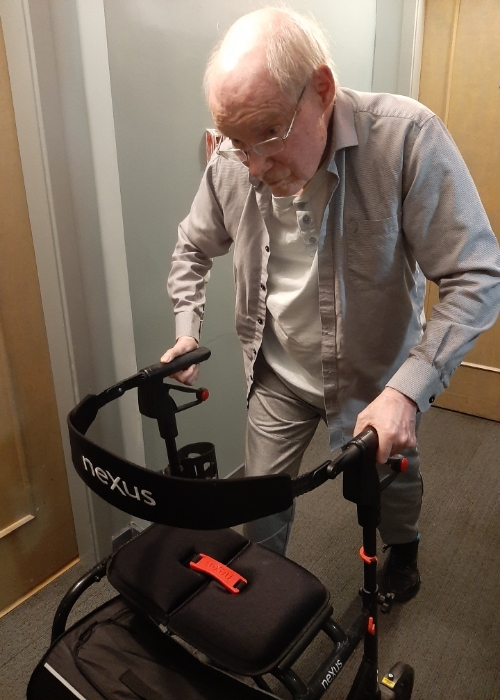
In January of 2020 Bernie had a fall that resulted in a spinal cord injury requiring surgery. This fall was likely the result of a TIA (mini stroke). He spent 10 weeks in hospital and then received Rehab at GF Strong Rehabilitation Centre in Vancouver. He was left with chronic nerve pain sensations in his left arm. In May 2022 he suffered a full stroke that made it difficult for Bernie to control movement in his right arm and leg. Stiffness is an everyday challenge. After 11 weeks in hospital and 9 weeks of physio at St. Paul’s Hospital, he manages at home with a walker, a splint for his right arm and a mobility scooter to ride outside.
POSITIVE MINDSET:
Bernie credits his love of reading and researching current events on his iPad as something that keeps him going. Fortunately his stroke did not affect his cognitive abilities. Bernie enjoys getting out to the Public Library for Book Club and visiting the West End Seniors Network for social events. He worries that he takes for granted the vigilant care that his wife provides for him. She is a task master when it comes to making sure he completes daily exercises and gives him massages every evening. A son visits twice per week, while their daughter is always researching activities her parents can join in the community.
GOALS FOR REHAB:
Bernie and his wife are determined to do what it takes for Bernie to stay as independent as possible with transfers and Activities of Daily Living. He wants to be able to get on and off of his new mobility scooter and climb the stairs up and down in the Handi-dart bus to travel to appointments and activities. His wife wants him to stay strong and improve his posture.
TREATMENT PROGRAM:
Physio for Seniors visits once per week to stretch and go over all of the exercises Bernie needs to maintain his mobility and quality of life. The most important work is to stand and walk. Bernie’s lumbar spine is flexed and he tends to fall backwards. He has forward head posture and his pelvis is rotated. Select muscles in his legs, right wrist, hand and forearm are tight due to the stroke. Biceps and triceps in both arms are knotted and tender due to the effects of stroke and from leaning heavily on his walker.
Physiotherapy with a Rehab Assistant includes leg stretching especially the glutes, hamstrings and lower back. Posture correction against the wall helps Bernie bring his upper back and head on top of his lower body through chin tucks and thoracic spine extensions. Deep tissue massage to forearms, triceps and biceps is provided. Sit-to-stands are performed and emphasis is placed on forward weight shift while standing to get more weight to the front and avoid falling back. Gait practice with marching, backwards walking, squats and heel raises help with balance to redirect the weight through the legs and out of the arms.
OUTCOME:
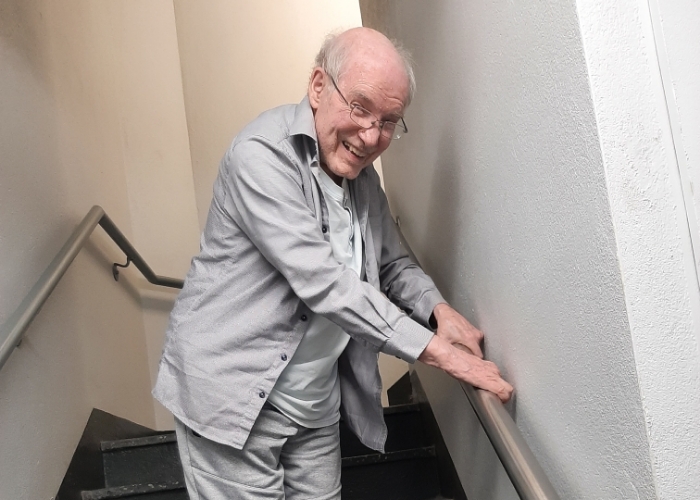
Bernie has been able to progress well in the last few months by building up his confidence and demonstrating that he has the strength to stand and walk without falling. He is now climbing stairs 6 up and 6 down with stand by assistance, holding onto the railing with two hands. He can take 4 or 5 steps at a time without his walker holding onto the arm of a helper which allows him to take his scooter to appointments and get himself into a chair. Bernie’s wife is happy that the Physiotherapist and Rehab Assistants at Physio for Seniors took the time to get to know Bernie so that he can progress and maintain his ability. It has given her peace of mind.
Judy F. 66 years old
Worked for Save on Foods and BC Liquor Stores, Mother of 2
HISTORY:
Judy has had a lot to deal with, but it has not affected her wonderful sense of humour. About 12 years ago Judy suffered a stroke and was diagnosed with a brain tumour. The stroke affected the left side of the body and left it weak. The brain tumour was removed successfully but symptoms of dementia (forgetfulness and confusion) remained. She copes with trigeminal neuralgic pain and has a history of falls while walking resulting in concussions. Judy needs a lot of assistance with at least one person and a transfer belt to help her with Activities of Daily Living. Her attentive husband is amazing and takes care of the majority of her needs. Judy uses a wheelchair during the day and a hospital bed at night. Previously she enjoyed an active lifestyle and played soccer.
POSITIVE MINDSET:
Judy’s approach to life and to her Rehab Program is light and cheery. She is quick to laugh and always has a funny joke to make the work fun. She credits her ability to enjoy life to her helpful husband who takes care of all her needs, including keeping her mind busy with jigsaw puzzles and artwork. Her husband reports that Judy “gets sleepy a lot” but naps and her favourite treat (a cup of tea) help her get through the days.
GOALS FOR REHAB:
The main objective of weekly visits from Physio for Seniors is to help make transfers easier for Judy and her husband. Both of them need to be safe and avoid injury when Judy gets a wash, uses the bathroom and transfers in and out of bed. The stronger Judy stays, the easier it is for both of them to remain independent. Judy is very keen to walk whenever she has the chance. Massage is her favourite.
TREATMENT:
Judy’s stroke-affected side requires active assistance to perform movements to maintain mobility and facilitate muscle contractions. Her stronger side is strengthened through resisted exercises using light manual resistance. Sit-to-stands from her chair with the help of a walker are practiced and once standing, she performs marching in place to improve her ability to lift her feet off the floor. As her pelvis tends to drop on one side when walking, she has been doing hip hikes to involve her glute muscles and control her forward steps better. The main focus of therapy is standing and walking as this requires 2 people assisting. Husband and Rehab Assistant work together to help Judy mobilize her legs. Bed mobility and core strengthening exercises were taught so that Judy and her husband can work on them daily. These include bridging, rolling side to side, clam shells, raising straight leg raises, mini sit-ups and deep breathing chest expansion,
OUTCOME:
After 4-5 weeks of strengthening and stretching along with sit-to-stands, squats and increasing endurance for weight bearing, Judy was ready to walk. She has increased her ability from walking 1 metre to walking up to 25 metres with her walker, walking belt and 2 people assisting. Weekly visits have helped Judy become more stable with her transfers, taking the pressure off her husband. She now stands up almost independently with better technique and more confidence. Her weak left side has become noticeably stronger – she is able to exercise it more actively and has achieved a greater range of motion in all her joints. The weak side now works in tandem with her strong side, allowing her to use both hands more actively at the table.
H.M Kay 78 years old
Retired Legislative Lawyer, Queen’s Counsel, Loving Husband and Father of 3
HISTORY:
Mr. Kay had a TIA (transischemic attack) or mini stroke in 2020. He was diagnosed with chronic heart failure presenting with aortic stenosis, atrial fibrillation and a reduced injection fraction (circulation insufficiency). In May of 2024 he had another more serious stroke resulting in right sided weakness. This CVA led to him becoming dependent on others for functional movement and care and he moved to a high level care facility in the same year. His family is very much involved in his life, helping to make good decisions in his best interest. Mr. Kay’s Physiotherapy Assessment showed reduced respiratory function and general weakness with a very low tolerance for activity. Even just sitting up in his wheelchair was very taxing for his energy levels. When started on his Rehabilitation Program, the sessions were only 15 minutes because the activity quickly tired him. He would often fall asleep right afterwards. Mr. Kay experienced pain in his lower back and in his right hand that needed manual therapy including massage.
POSITIVE MINDSET:
In spite of his challenges Mr. Kay always greets the Physio Rehab Team with a smile. His face lights up with any mention of his wife and family. He is a friendly, soft-spoken gentleman who accepts the exercise routines graciously while doing his best to improve. Although verbal communication is limited, he is able to let us know how he feels, what hurts and what makes him feel better, enabling us to help him every step of the way.
GOALS FOR REHAB:
Mr. Kay needed to increase his overall endurance to be able to sit up in his wheelchair and spend less time in a hospital bed. Improving transfers for ease of everyday care was important to avoid injury and pain to his joints. General conditioning to increase respiratory efficiency, functional movement, and quality of life was very important.
TREATMENT:
Treatment consisted of passive range of motion for upper and lower extremities to ensure flexibility in all joints. Most sessions were administered in his bed, but over the weeks and months he progressed to work more often in a seated position. Grip strengthening improved by holding and manipulating objects of various sizes and shapes. As Mr. Kay became stronger, he was able to participate more in active-assisted exercises. Functional movement of his strong side progressed to increased repetitions of active exercises. Massage to relieve lower back pain and right hand discomfort was appreciated.
OUTCOME:
Now, in October 2025, we are happy to see that Mr. Kay can manage 30 minute Rehab Exercise sessions. His endurance has improved to allow him to sit up in his wheelchair for longer periods so he now attends more activities offered at his care home. Mr. Kay uses the Active-Passive Trainer Bike on a passive setting to increase joint mobilization and circulation. This is helping with swelling in his ankles and feet. Gradually adding more active movement is welcomed and achieved with a smile. Deep breathing exercises increased respiratory function giving him more energy and endurance during the day.
Cardio Vascular Accidents (CVAs), commonly known as strokes, can have debilitating effects on people. Every person and every stroke is unique. And yet, behind every stroke there is a story of resilience and hope. Small day to day victories are celebrated as we learn more about what we can all do to help people. We know people can make a full recovery if life-saving treatment is administered quickly enough. What is perhaps less known, is that improvements can happen months or even years after suffering a stroke. That’s where regular Rehab can be invaluable.
On October 29th, World Stroke Awareness Day, the Physiotherapists and Rehabilitation Assistants at Physio for Life/ Physio for Seniors acknowledge stroke survivors, their families and carers as they face challenges. We will not stop looking for ways to help while exploring what works for each and every client.